Artificial Intelligence has evolved rapidly over the last few years. Most people are familiar with AI chatbots that can answer questions, write content, summarize documents, and assist with various day-to-day tasks.
However, modern AI systems are moving beyond simply answering questions.
Today, businesses and developers are exploring a new approach known as Agentic AI. Instead of only responding to prompts, these AI systems can plan tasks, make decisions, use tools, and work toward achieving a specific goal.
This shift is changing the way organizations use AI for automation, productivity, customer support, research, and business operations.
But what exactly is Agentic AI, and why is everyone talking about it?
Let's understand it step by step.
What is Agentic AI?
Agentic AI refers to AI systems that can take actions to accomplish a goal rather than simply generating responses.
Traditional AI models are reactive. They wait for a user prompt, generate a response, and stop there.
Agentic AI goes a step further.
These systems can:
• Understand objectives
• Break tasks into smaller steps
• Decide what actions to perform
• Use available tools
• Analyze results
• Continue working toward a goal
In simple terms, Agentic AI focuses on completing tasks rather than only answering questions.
Think of it this way:
A chatbot is like an assistant who answers your questions.
An AI agent is like an assistant who can answer questions, perform tasks, gather information, and help you reach a specific outcome.
This ability to act is what makes Agentic AI different from traditional AI systems.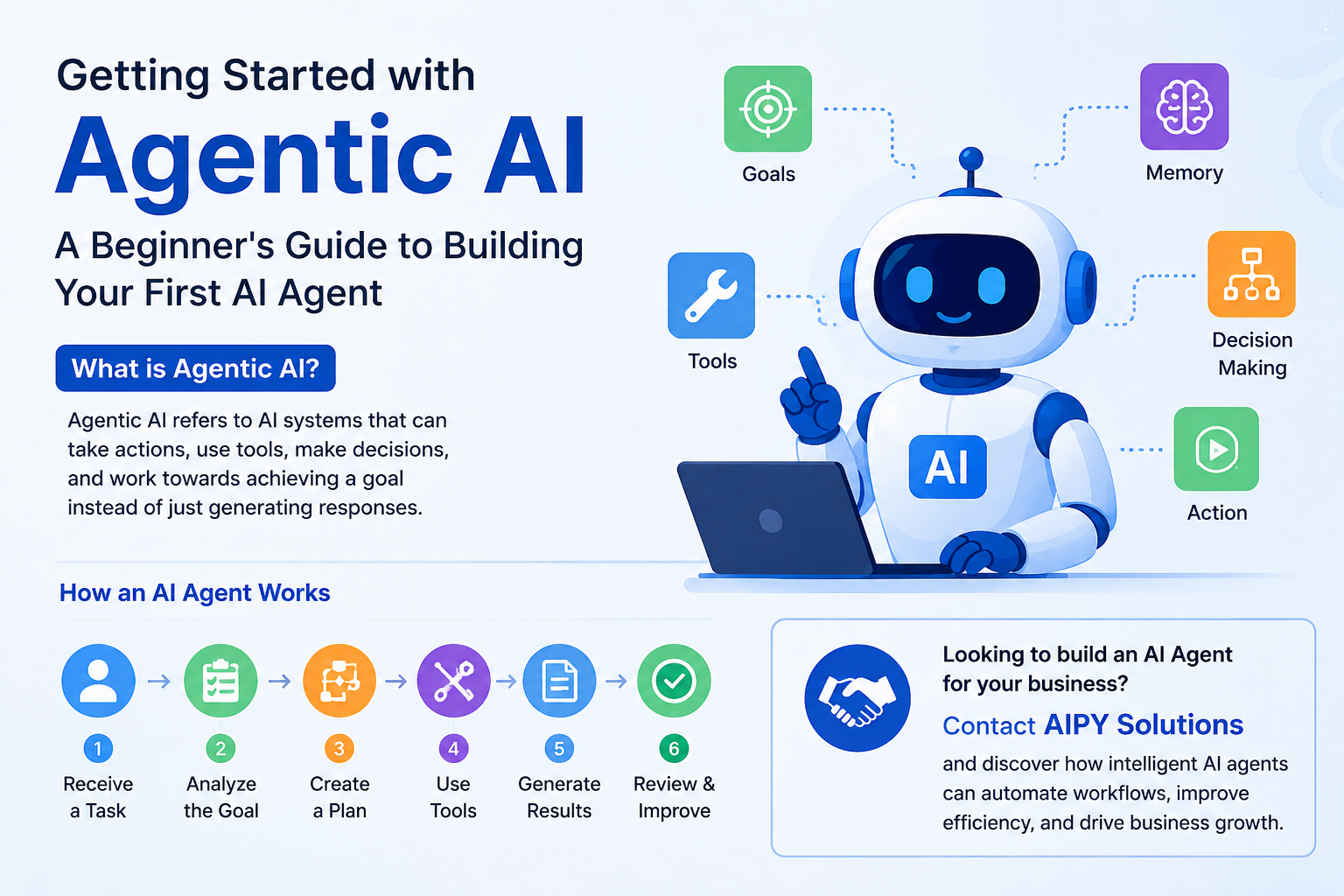
Why is Agentic AI Important?
Businesses are constantly looking for ways to automate repetitive work and improve productivity.
While traditional AI can provide useful information, many business processes require more than just answers.
Organizations need systems that can:
• Research information
• Analyze data
• Perform actions
• Follow workflows
• Assist employees with complex tasks
This is where Agentic AI becomes valuable.
Instead of requiring users to manually perform every step, AI agents can help execute parts of the workflow automatically.
Some common use cases include:
• Customer support automation
• Research assistants
• Scheduling systems
• Document processing
• Workflow automation
• Internal knowledge assistants
As AI technology continues to improve, Agentic AI is becoming one of the most practical ways for businesses to implement intelligent automation.
Understanding the Core Components of an AI Agent
Before learning how AI agents work, it is important to understand the main building blocks behind them.
Every AI agent is typically made up of several components that work together.
Goal
Every agent starts with a goal.
The goal defines what the system is trying to achieve.
For example:
• Plan a trip
• Answer customer questions
• Summarize documents
• Generate reports
Without a goal, an agent has no direction.
Planning
Once a goal is provided, the agent must determine how to accomplish it.
This process is called planning.
Instead of solving everything at once, the agent breaks the task into smaller steps.
For example, if the goal is to create a travel itinerary, the agent may:
• Research destinations
• Find attractions
• Organize activities
• Create a schedule
Planning allows the agent to approach complex tasks in a structured manner.
Tools
AI agents often need access to external tools.
Large Language Models are powerful, but they cannot perform every task on their own.
To extend their capabilities, agents can use tools such as:
• Search engines
• Databases
• APIs
• Documents
• Business applications
These tools help agents gather information and perform actions beyond simple text generation.
Memory
Another important component is memory.
Memory allows the agent to remember useful information while completing a task.
This helps the system maintain context and avoid repeating work.
For example, a customer support agent may remember previous interactions during a conversation and use that information when generating responses.
Decision Making
After gathering information, the agent must decide what to do next.
Decision-making helps determine:
• Which tool should be used
• What information is relevant
• Which action should be taken next
This is one of the key capabilities that separates AI agents from traditional chatbots.
How Does an AI Agent Work?
Now that we understand the components, let's look at the complete workflow.
A typical AI agent follows a sequence of steps.
Step 1: Receive a Task
The user provides a goal or instruction.
Example:
"Help me create a weekend travel plan."
Step 2: Analyze the Goal
The agent understands the request and identifies what needs to be done.
Step 3: Create a Plan
The task is divided into smaller steps.
The agent decides how it will approach the problem.
Step 4: Use Tools
The agent accesses available tools and gathers information required for the task.
Step 5: Generate Results
The collected information is processed and transformed into a useful output.
Step 6: Review and Improve
Some advanced agents can evaluate their own output and make improvements before presenting the final result.
This entire workflow allows AI agents to perform tasks in a more structured and intelligent manner than traditional AI systems.
LLMs vs AI Agents
Many beginners often confuse Large Language Models (LLMs) with AI agents.
Although they are closely related, they are not the same thing.
An LLM is responsible for understanding and generating language.
An AI agent uses an LLM as one of its components but adds planning, memory, tools, and decision-making capabilities on top of it.
In simple terms:
• An LLM generates responses
• An AI agent generates responses and performs actions
This is one of the most important concepts to understand when learning Agentic AI.
Businesses are increasingly exploring AI agents to automate repetitive tasks, improve productivity, and streamline business operations. As Agentic AI continues to evolve, organizations are finding new ways to build intelligent systems that can not only answer questions but also take actions and complete tasks.
Whether it is customer support, document processing, workflow automation, research assistance, or internal knowledge management, AI agents are becoming a practical solution for modern businesses.
Looking to build an AI Agent for your business? Contact AIPY Solutions and discover how intelligent AI agents can help automate workflows, improve efficiency, and accelerate business growth.
Ready to Build Your AI Solution?
Our team designs, deploys, and scales AI systems around the workflows that matter most to your business.
Get a Free Consultation