Many business processes involve repetitive tasks that consume valuable time and resources. AI can automate these tasks, allowing employees to focus on more strategic and high-value work.
In this article, we will discuss the top 10 business processes that can be automated using AI and how organizations can benefit from implementing intelligent automation.
One of the most common use cases of AI is customer support automation.
Businesses receive hundreds or even thousands of customer inquiries every day. Many of these questions are repetitive and require similar responses. AI-powered chatbots and virtual assistants can handle these interactions automatically.
Some common tasks include:
• Answering frequently asked questions
• Providing order updates
• Assisting customers with basic troubleshooting
• Escalating complex issues to support agents
This helps businesses provide faster support while reducing operational costs.
Organizations deal with a large number of documents such as invoices, contracts, forms, purchase orders, and reports.Manually processing these documents can be time-consuming and error-prone.
AI-powered document processing systems can:
• Extract information from PDFs and scanned documents
• Classify documents automatically
• Convert unstructured data into structured formats
• Validate and process business records
This significantly reduces manual effort and improves accuracy.
3. Resume Screening and Recruitment
Hiring teams often spend considerable time reviewing resumes and shortlisting candidates.
AI can automate the initial screening process.
AI recruitment systems can:
• Analyze resumes
• Match candidates with job requirements
• Rank applicants based on skills and experience
• Generate candidate summaries
This allows recruiters to focus on interviewing qualified candidates rather than manually reviewing hundreds of applications.
Many employees spend a significant portion of their day managing emails.
AI can help automate several email-related tasks.
Some examples include:
• Categorizing emails
• Generating email responses
• Prioritizing important messages
• Routing emails to appropriate teams
This helps improve productivity and reduces response times.
5. Invoice Processing
Finance teams often process invoices manually, which can lead to delays and errors.
AI-powered invoice automation systems can:
• Extract invoice details
• Validate supplier information
• Match invoices with purchase orders
• Flag discrepancies automatically
This helps accelerate financial operations and improve accuracy.
Not every lead that enters the sales pipeline is ready to make a purchase.
Sales teams can waste significant time pursuing low-quality leads.
AI can analyze lead behavior and identify high-potential prospects.
AI systems can:
• Score leads automatically
• Analyze customer interactions
• Predict buying intent
• Recommend follow-up actions
This helps sales teams focus on opportunities that are most likely to convert.
7. Knowledge Management
Businesses generate a large amount of information through policies, manuals, reports, and internal documentation.
Finding the right information at the right time can be challenging.
AI-powered knowledge assistants can:
• Search company documents
• Answer employee questions
• Retrieve relevant information instantly
• Provide source references
This improves productivity and reduces time spent searching for information.
8. Appointment Scheduling
Scheduling meetings often involves multiple emails and back-and-forth communication.
AI can automate the scheduling process.
AI scheduling assistants can:
• Check calendar availability
• Schedule meetings automatically
• Send reminders
• Handle rescheduling requests
This creates a smoother experience for both employees and customers.
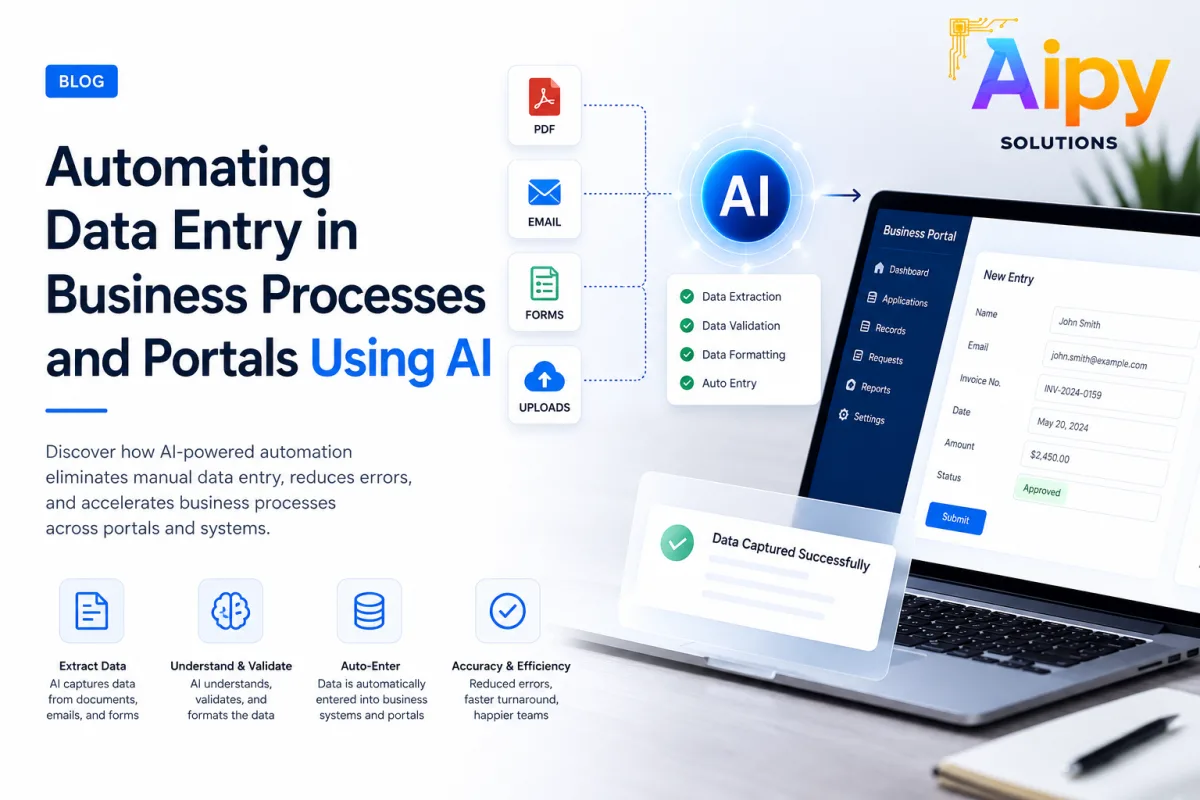
9. Data Entry
Data entry remains one of the most repetitive tasks across many industries.
Manual data entry not only consumes time but also increases the risk of human error.
AI systems can:
• Capture information from documents
• Validate entered data
• Update databases automatically
• Reduce manual intervention
This helps improve data quality and operational efficiency.
Many organizations spend hours creating weekly and monthly reports.
AI can automate report creation by collecting and analysing data from multiple sources.
AI reporting systems can:
• Generate business reports automatically
• Create performance summaries
• Identify trends and anomalies
• Provide actionable insights
This allows decision-makers to access information faster and make informed business decisions.
Why Businesses Are Investing in AI Automation
The goal of AI automation is not simply to replace manual work.
Instead, it helps organizations:
• Reduce repetitive tasks
• Improve operational efficiency
• Minimize human errors
• Increase productivity
• Improve customer experience
• Enable employees to focus on higher-value activities
As AI technologies continue to evolve, more businesses are discovering opportunities to automate processes that were once considered difficult or impossible to streamline.
Final Thoughts
AI automation is no longer limited to large enterprises. Businesses of all sizes can now leverage AI to improve efficiency and streamline operations.
Whether it is customer support, document processing, recruitment, sales, or reporting, AI can help organizations save time, reduce costs, and improve overall business performance.
The key is to identify repetitive and time-consuming processes where automation can deliver the greatest impact.
Looking to automate business processes using AI? Contact AIPY Solutions and discover how intelligent automation can help transform your business operations.
Ready to Build Your AI Solution?
Our team designs, deploys, and scales AI systems around the workflows that matter most to your business.
Get a Free Consultation