There is a nurse somewhere right now who spent the last 45 minutes filling out forms.
Not treating patients. Not reviewing symptoms. Not doing the thing she trained years to do.
Filling out forms.
And she is not alone.
Across healthcare — hospitals, clinics, diagnostic centers, insurance companies — an enormous amount of time, money, and human energy is consumed by administrative work. Scheduling, billing, coding, prior authorizations, record management, compliance documentation. Work that is necessary, but that does not directly heal anyone.
The burden is staggering. Studies suggest that for every hour a physician spends with a patient, they spend nearly two additional hours on administrative tasks. For nurses and support staff, the ratio is often even worse.
And the cost of this is not just financial. It is human.
Physician burnout is at record highs. Staff turnover in healthcare administration is expensive and disruptive. Patients experience delays. Errors happen. And the organizations that deliver care spend more time managing paperwork than managing health outcomes.
AI is beginning to change that.
Not by replacing doctors or nurses — but by taking on the administrative burden that was never a good use of their time in the first place.
What is AI-Powered Healthcare Administration?
Healthcare administration covers everything that keeps a healthcare organization running outside of direct clinical care. That includes:
- Patient registration and onboarding
- Appointment scheduling and reminders
- Insurance verification and pre-authorization
- Medical coding and billing
- Claims processing and follow-up
- Clinical documentation and EHR data entry
- Compliance and regulatory reporting
- Staff scheduling and resource allocation
Traditionally, all of these processes involve significant manual effort, multiple software systems, phone calls, faxes, and a lot of human coordination.
AI-powered healthcare administration applies machine learning, natural language processing, and intelligent automation to these workflows. The result is processes that are faster, more accurate, less expensive, and far less dependent on manual human effort.
| Important distinction: AI in healthcare administration is not about clinical decision-making or diagnosis. It is about the operational and administrative layer — the scaffolding that holds a healthcare organization together — and making it run more efficiently.
Where AI is Making the Biggest Difference
1. Intelligent Appointment Scheduling
Scheduling seems simple. It is not.
Healthcare scheduling involves managing physician availability, room availability, equipment bookings, patient preferences, urgency levels, appointment duration variability, no-show rates, and the need to leave buffer time for emergencies. Getting it right requires constant juggling.
AI scheduling systems do this by:
- Predicting no-show probability based on patient history and sending targeted reminders
- Automatically filling cancelled slots with patients on waiting lists
- Recommending appointment slots that minimize gaps and optimize physician time
- Handling patient self-scheduling via intelligent chatbots, available 24/7
- Triaging appointment requests based on urgency flags in the patient query
Tools like Zocdoc, Luma Health, and Klara are already deploying AI-driven scheduling at scale in healthcare settings.
| Real Result: AI-powered scheduling typically reduces no-show rates by 25–40% and increases physician utilization without adding administrative staff.
2. Medical Coding and Billing Automation
Medical coding is one of the most technically demanding administrative jobs in healthcare. Coders translate physician notes, diagnoses, and procedures into standardized ICD-10, CPT, and HCPCS codes used for insurance billing.
The problem is that this process is:
- Time-consuming — a single complex patient encounter can take 20 to 30 minutes to code
- Error-prone — coding errors are a leading cause of claim denials
- Expensive — qualified medical coders are in short supply and high demand
- High stakes — undercoding costs revenue, overcoding creates compliance risk
AI medical coding tools use Natural Language Processing (NLP) to read clinical notes and automatically suggest the correct codes. The most advanced systems achieve first-pass accuracy rates above 95%, far exceeding average human performance.
Companies like Optum360, 3M Health Information Systems, and Nym Health are leading this space with AI-assisted and fully autonomous coding solutions.
3. Insurance Pre-Authorization
Ask any physician what frustrates them most about their job, and prior authorization will almost certainly come up.
Pre-authorization — the process of getting insurance approval before proceeding with a treatment, test, or medication — is one of the most disruptive administrative bottlenecks in healthcare.
On average, physicians and their staff spend over 13 hours per week dealing with prior authorizations. Patients often wait days or weeks for approvals. Many give up and do not receive care they need.
AI is changing this in two ways.
First, AI systems can automatically pull together all the clinical evidence needed for an authorization request — diagnosis codes, clinical notes, lab results, previous treatment history — and submit complete, accurate requests the first time, dramatically reducing denials and re-submissions.
Second, AI tools that learn from past approval patterns can predict whether a specific treatment will be approved for a specific patient and insurer, allowing clinical staff to make more informed decisions about how to proceed before getting into the authorization process.
Solutions like Cohere Health and Olive AI are specifically designed to automate the prior authorization workflow end to end.
4. Clinical Documentation and EHR Data Entry
This is the one that physicians feel most directly.
Electronic Health Record (EHR) systems were supposed to make healthcare more efficient. In many cases, they have done the opposite. Physicians spend enormous amounts of time typing notes, clicking through menus, and documenting encounters in systems designed more for billing than for clinical care.
AI is addressing this through ambient clinical intelligence — technology that listens to a doctor-patient conversation and automatically generates structured clinical notes.
The physician has the conversation. The AI listens, understands the clinical context, and produces a draft note — including diagnosis, treatment plan, medications, and follow-up — which the physician reviews and approves.
The result? Documentation time drops from 15 to 20 minutes per encounter to 2 to 3 minutes for review.
Nuance DAX (now part of Microsoft), Suki AI, and Nabla are the leading ambient AI documentation platforms in use today, with tens of thousands of physicians already using them.
| Physician Feedback: Early adopters of ambient AI documentation consistently report it as one of the most meaningful changes to their work life in years — giving them back time for patients and reducing the documentation burden driving burnout.
5. Claims Management and Revenue Cycle
Healthcare revenue cycle management — the process of getting paid for services rendered — is notoriously complex. A single claim touches multiple systems, involves multiple parties, and can be denied for dozens of different reasons.
Denied claims are expensive. Resubmitting a denied claim costs around $25 on average. For large health systems processing hundreds of thousands of claims, even a small improvement in first-pass acceptance rates has significant financial impact.
AI tools in revenue cycle management:
- Predict which claims are likely to be denied before submission and flag them for review
- Automatically identify and correct common coding and billing errors
- Prioritize the follow-up queue by denial reason and recovery probability
- Analyze denial patterns across payers to identify systemic issues
- Automate eligibility verification before patient appointments
Companies like Change Healthcare, Waystar, and Nuvei Health offer AI-powered revenue cycle platforms used by major health systems.
6. Patient Communication and Engagement
A large portion of healthcare administration involves communicating with patients — appointment reminders, follow-up instructions, test results, medication reminders, billing queries, and general inquiries.
AI-powered patient communication tools handle this at scale:
- Automated appointment reminders via SMS, email, or WhatsApp with two-way confirmation
- AI chatbots that answer common patient questions 24 hours a day
- Automated post-visit follow-up messages and satisfaction surveys
- Intelligent routing of patient messages to the right clinical or administrative team
- Multilingual communication without additional staffing
For patients, this means faster responses and less time on hold. For staff, it means fewer interruptions and more time for complex tasks that genuinely need human attention.
7. Staff Scheduling and Workforce Management
Healthcare workforce management is uniquely challenging. Patient volume fluctuates. Staff have different certifications, roles, and availability. Labor regulations add complexity. And getting it wrong — whether understaffed or overstaffed — is expensive and affects patient care.
AI workforce management systems analyze historical patient volume patterns, seasonal trends, procedure mix, and staff availability to generate optimized schedules automatically.
They can:
- Predict patient volumes days or weeks ahead
- Generate compliant schedules that respect labor rules and staff preferences
- Alert managers when coverage gaps are emerging
- Automatically identify and contact available staff when unexpected absences occur
- Reduce overtime costs by distributing hours more intelligently
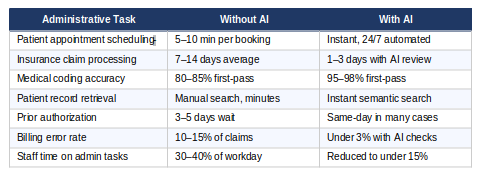
The Numbers: AI vs. Manual Administration
Here is a practical comparison of what AI-powered administration delivers versus traditional manual processes:
Compliance, Privacy, and the Regulatory Dimension
Healthcare data is among the most sensitive data that exists. Any AI system operating in healthcare administration must be designed with compliance as a foundational requirement — not an afterthought.
In the United States, this means HIPAA compliance — strict rules around the handling, storage, transmission, and access of Protected Health Information (PHI).
In Europe, healthcare data is subject to GDPR provisions, with additional requirements under the EU AI Act for high-risk AI applications.
In India, the Digital Personal Data Protection Act (DPDP) is bringing new requirements for healthcare data handling as it comes into force.
What this means practically for AI in healthcare administration:
- AI vendors must provide Business Associate Agreements (BAAs) under HIPAA
- Patient data used to train AI models must be properly de-identified or consented
- Data residency requirements must be respected in cloud deployments
- Audit trails must be maintained for all AI-assisted decisions
- Patients must retain rights to access and correction of their data
The good news is that the major enterprise AI vendors — Microsoft, Google, Amazon, and others — have invested heavily in HIPAA-compliant infrastructure. The compliance burden is real but manageable with the right platform choices.
What a Real Implementation Looks Like
Understanding the technology is one thing. Actually implementing it in a healthcare organization is another.
Here is a realistic picture of how an AI healthcare administration project typically unfolds:
- Start with the highest-pain process — do not try to automate everything at once. Pick the one process that consumes the most time, has the highest error rate, or creates the most friction for staff and patients. For most organizations, this is either medical coding, appointment scheduling, or prior authorization.
- Audit your current data quality — AI systems are only as good as the data they work with. Before deploying, assess whether your EHR data, patient records, and historical claims data are in a usable state. Data cleanup is often the most time-consuming part of any AI project.
- Choose the right vendor or build approach — For most administrative AI applications, buying or subscribing to a specialized vendor solution is faster and safer than building from scratch. Evaluate vendors specifically on their healthcare compliance credentials, EHR integration capabilities, and reference customers similar to your organization.
- Integrate with your EHR system — The AI tool needs to connect to your Electronic Health Record system. Major EHRs like Epic, Cerner, and Athenahealth have developer platforms and App Orchard / marketplace systems that make integration more straightforward.
- Involve clinical and administrative staff early — The people who will use and be affected by these tools need to be involved in the selection and configuration process. AI tools that are technically strong but do not fit real workflows get abandoned. Staff engagement is not optional.
- Run a pilot with clear success metrics — Before full deployment, run a time-limited pilot in one department or facility. Define success metrics upfront: reduction in processing time, improvement in first-pass claim acceptance rate, reduction in scheduling no-shows, physician documentation time saved.
- Scale with continuous feedback — After a successful pilot, expand carefully. Build feedback mechanisms so staff can flag errors or edge cases, and ensure your AI vendor incorporates that feedback into model improvements.
The Challenges Worth Being Honest About
This technology is genuinely powerful. But it is worth being direct about the real challenges that healthcare organizations face when adopting it.
- Integration with legacy systems is harder than it looks. Many healthcare organizations run on EHR systems and billing platforms that are years or decades old, with limited API access and inconsistent data structures. Getting AI tools to work with these systems often requires more engineering effort than anticipated.
- Change management is the real challenge. Technology implementation in healthcare is as much an organizational challenge as a technical one. Physicians and administrative staff who are used to doing things a certain way will push back. Getting leadership alignment and investing in proper training is essential.
- AI confidence levels need human oversight. Even the best AI coding, prior authorization, or documentation tools make mistakes. Every deployment needs a well-designed human review process for edge cases and low-confidence outputs. The goal is to reduce manual work significantly, not to eliminate human judgment entirely.
- Data quality problems surface quickly. If your current records are inconsistent, incomplete, or stored in incompatible formats, the AI will amplify those problems. Investing in data quality before an AI deployment is not exciting work, but it is usually necessary.
- Cost vs. ROI timelines vary. Some AI tools deliver ROI within months. Others require a longer runway. Be realistic about implementation costs, training time, and the period before you see full benefits. Build a proper business case.
What This Means for Healthcare Staff
There is always a question when AI enters the workplace: what does this mean for the people who currently do this work?
In healthcare administration, the honest answer is: it means different work, not no work.
The tasks that AI automates well — repetitive data entry, routine coding, standard scheduling, basic patient queries — are not the tasks that require human empathy, judgment, or complex problem-solving.
When AI handles the repetitive load, administrative staff can focus on:
- Complex cases that require human judgment and communication
- Patient interactions that benefit from empathy and relationship
- Exception handling and quality review
- Process improvement and optimization
- Supporting clinical staff with more complex coordination tasks
For physicians, the benefit is even more direct. Less time on documentation means more time with patients, better work-life balance, and lower burnout risk.
The organizations that manage this transition well will retain and attract better talent. The ones that deploy AI without thinking about their people will lose the staff they are trying to help.
Conclusion
Healthcare administration is broken in ways that are visible to everyone who works in it or depends on it.
The paperwork burden on clinical staff is a real contributor to burnout and turnover. The delays in authorization and billing hurt patients and providers alike. The error rates in coding and claims cost the system billions of dollars every year.
AI does not solve every healthcare problem. But for healthcare administration specifically, it is one of the clearest and highest-impact applications of the technology available today.
Intelligent scheduling, automated medical coding, ambient documentation, AI-assisted prior authorization, smarter revenue cycle management — these are not futuristic possibilities. They are tools that hospitals and clinics are deploying right now, with measurable results.
The question for healthcare organizations is not whether AI will transform administration. It already is.
The question is whether your organization will lead that transformation or spend the next five years watching competitors who did.
If you want to explore what AI-powered healthcare administration could look like for your organization, visit AIPY Solutions and let's build it together.
Ready to Build Your AI Solution?
Our team designs, deploys, and scales AI systems around the workflows that matter most to your business.
Get a Free Consultation